[Understanding Tea Ceremony #10] Kekkai (Boundary Markers)
Are you familiar with a tea tool called “Kekkai”? It is placed at the boundary between the “Dogu-datami” (the mat where the host prepares tea) and the “Kyaku-datami” (the mat where the guests sit) to indicate the host’s domain. It implicitly shows the area where guests should not enter. However, it is not something like a screen that blocks the view; rather, it subtly marks the boundary.
Kekkai as a Tea Tool
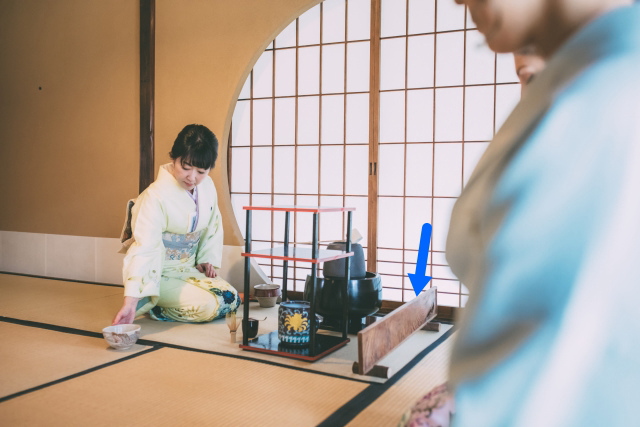
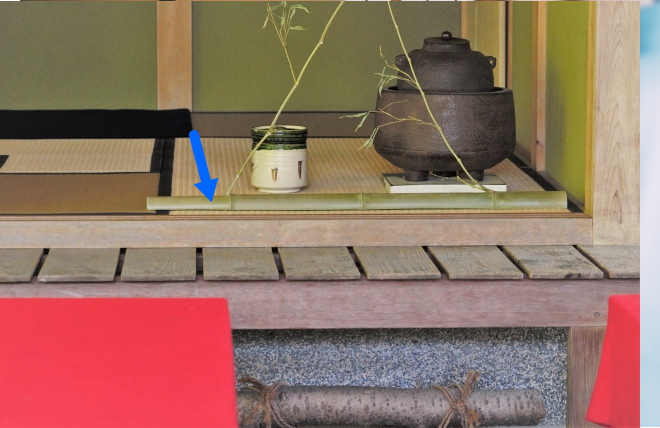
Kekkai are not necessarily placed at every tea gathering, but the following photo is an example of when one is used. The blue arrow points to the Kekkai.
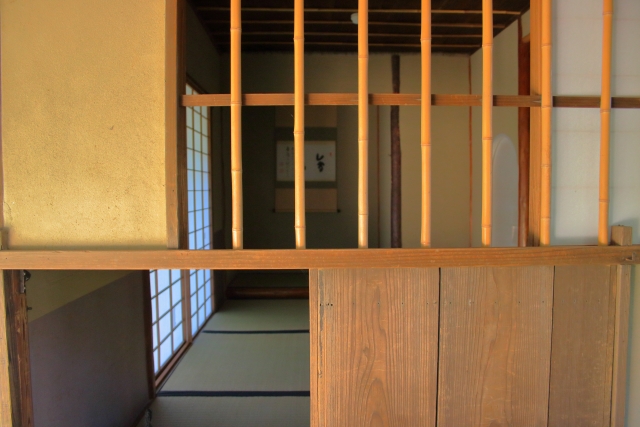
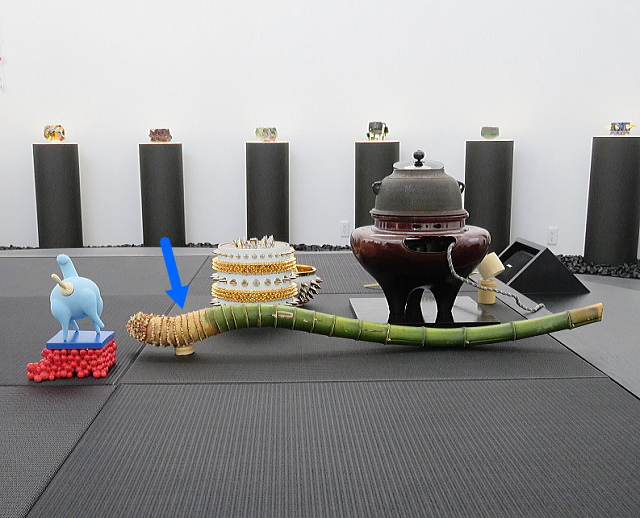
In a rare instance, among the Japanese art exhibits at the Expo 2025 Osaka, Kansai, there was a piece themed around a tea room that also used a Kekkai. From the guest’s perspective, the item made of bamboo in the very foreground is the Kekkai.
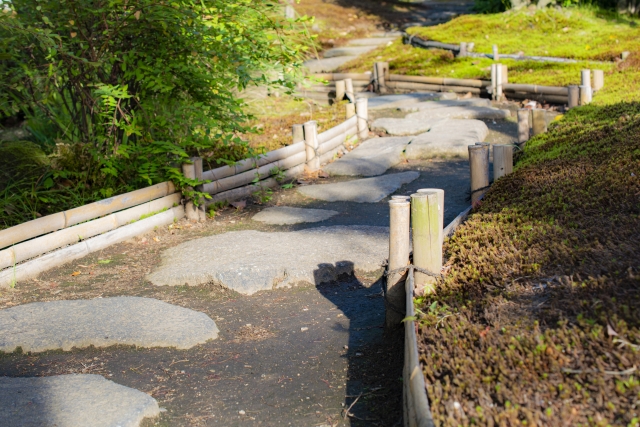
Like this one, many Kekkai used in tea ceremonies are made of bamboo. This is said to follow the tradition of installing “Takegaki” (bamboo fences) in Japanese gardens to mark areas where entry is prohibited.
However, Kekkai are not limited to bamboo; they come in various materials and forms. They serve not only as a simple boundary but are also designed for guests to enjoy visually.
A Rare “Glass Kekkai”
https://www.ueda-soukoryu.com/2024/09/25/new2409/
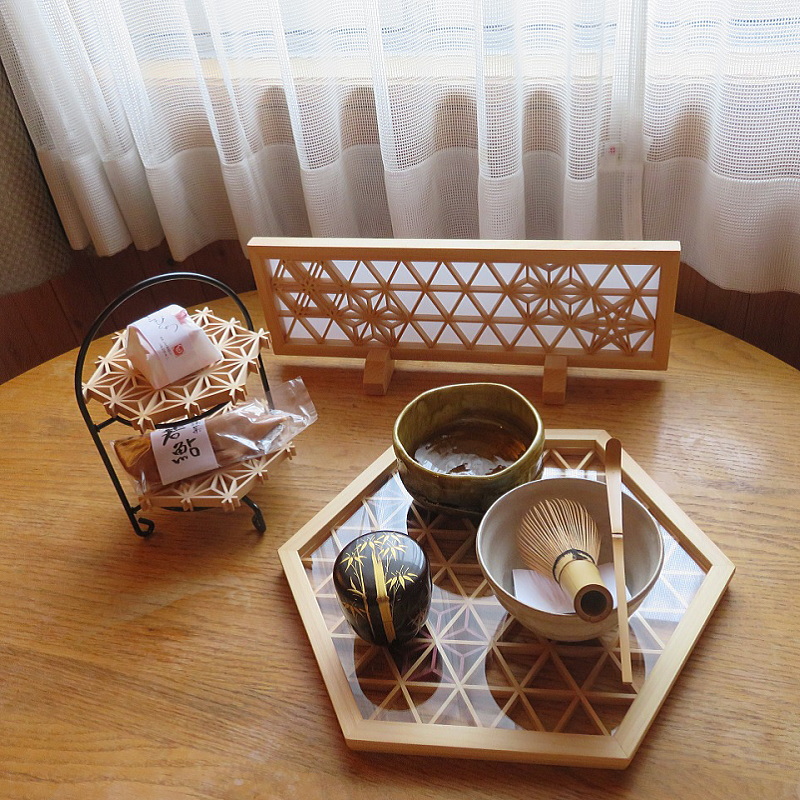
Kumiko Panels that can also be used as Kekkai
Explore more details
The Meaning of Kekkai
When we think of “Kekkai,” images of shrine torii gates, shimenawa (sacred rice-straw ropes), and shide (zigzag-shaped paper streamers) often come to mind. However, the term originally has its roots in Buddhist terminology, meaning a boundary that separates a sacred area from the secular world. It is believed that this concept was incorporated into the tea ceremony during the Azuchi-Momoyama period, when Sen no Rikyu was active.
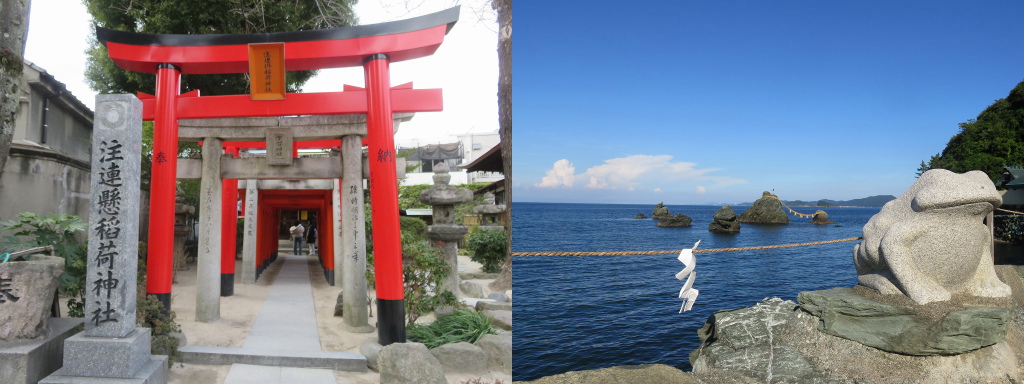
Kekkai Before Entering the Tea Room
In the tea ceremony, Kekkai are established even before one enters the tea room. A tea room is accompanied by a garden called “Roji.” The space of Chanoyu (the tea ceremony) is composed of both the tea room and the outdoor Roji as a single integrated unit.
Roji (The Tea Garden)
Roji is a garden that provides the path leading to the tea room, also known as a “Chaniwa” (tea garden). It is a space to calm one’s mind and prepare to enter the world of tea, leaving behind the hustle and bustle of daily life. The gate to enter the Roji is called the “Rojimon,” and it is designed to create a simple and modest atmosphere.
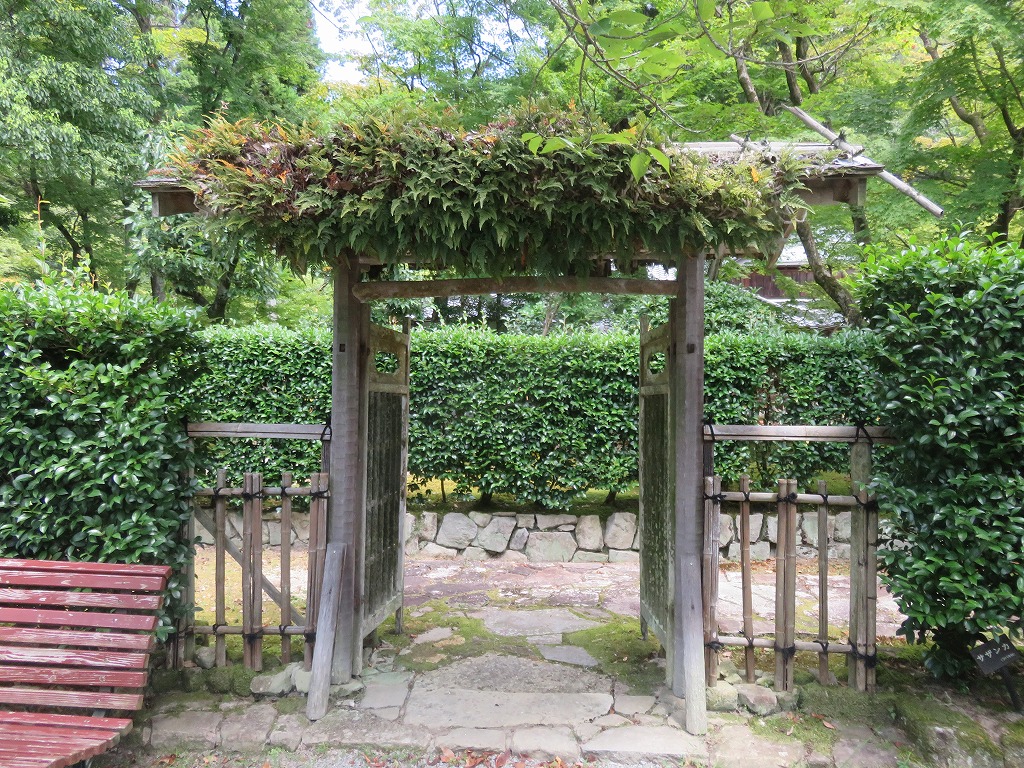
In the Roji, stepping stones called “Tobi-ishi” are placed as a pathway. By following these stones, guests reach the entrance of the tea room.
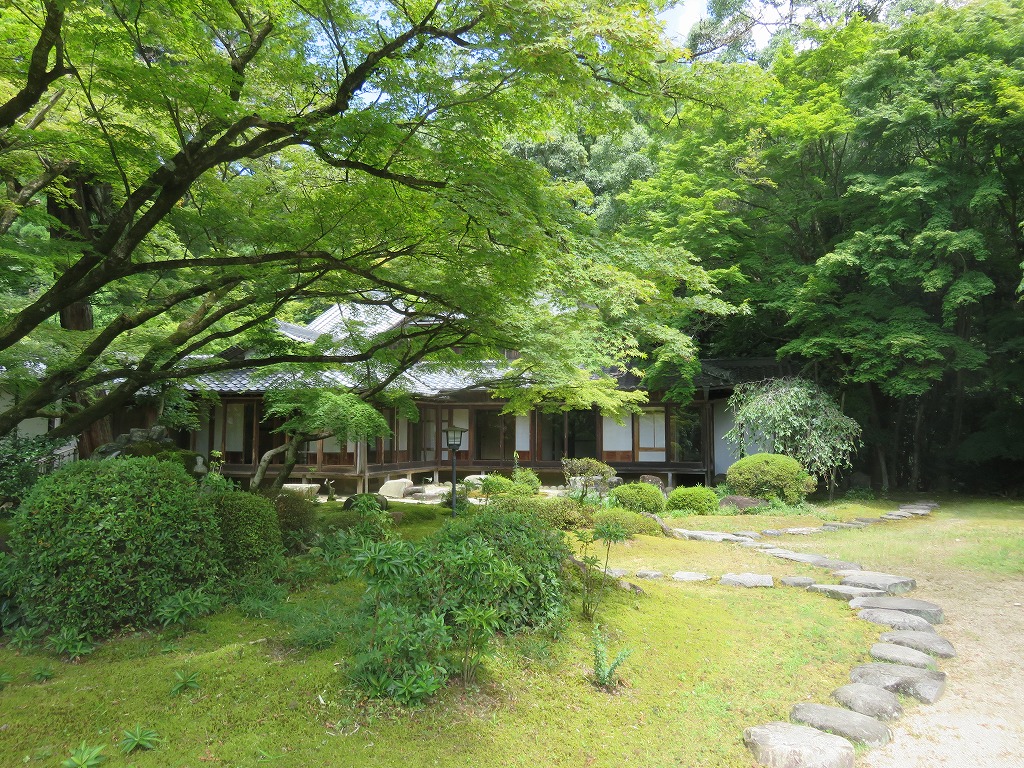
You can find an introduction to Shyuentei here:https://matsuri-ja.com/en/blog/building/tatsuno/
On the way to the tea room, there is a “Tsukubai” (stone washbasin). Water is collected in a stone basin with a hollowed-out center, and a “Hishaku” (ladle) is placed there. Guests wash their hands and rinse their mouths here to purify themselves.
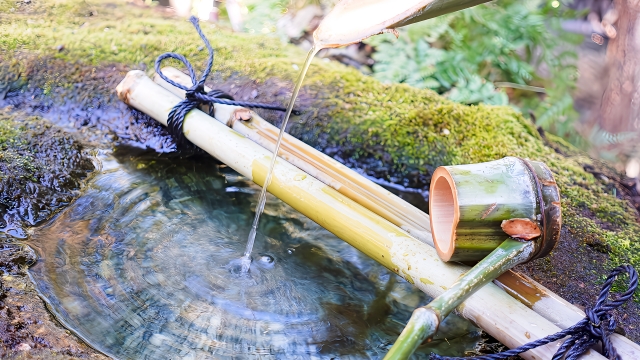
Thus, the Roji is a space to purify both mind and body in preparation for entering the tea room. It can be described as playing the role of a Kekkai itself, or a space designed for crossing that boundary.
Nijiriguchi (The Crawling Entrance)
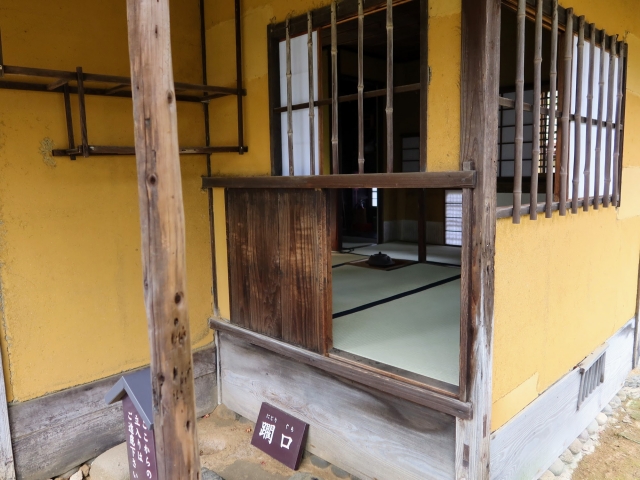
The final mechanism to thoroughly shed the dust and impurities of the secular world is the “Nijiriguchi.” This is a small entrance, about 60 cm square, used to enter and exit the tea room. No matter how high one’s social status, no one can enter without bowing their head and crouching down. Since samurai could not pass through with their swords equipped, they had to leave them on the “Katana-kake” (sword rack) outside. This carries the symbolic meaning of “Please leave the ‘dust of the secular world,’ such as social status and rank, outside before entering the tea room.”
Kekkai Created by a Folding Fan
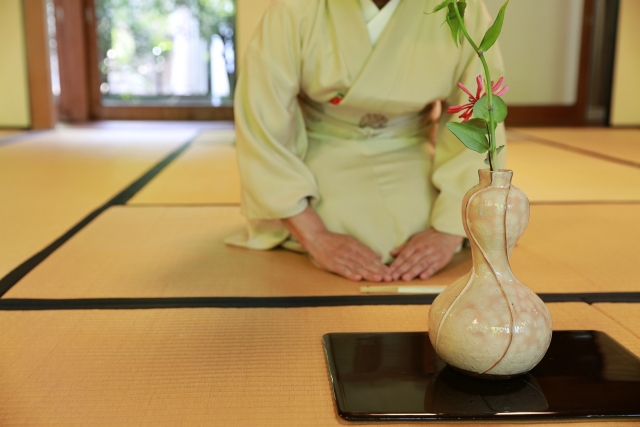
In the tea ceremony, a folding fan (Sensu) is used as a tool to create a “Kekkai” (boundary). When giving a formal greeting, entering the tea room, or appreciating the tea tools, you place the fan on the floor in front of your knees while seated. There is a theory that this action is a remnant of when samurai would exchange their swords for fans before entering the tea room, placing the fan in front of them to demonstrate that they held no hostility toward the other person.
By learning about the concept of Kekkai in the tea ceremony, one can gain a deep understanding of the historical background and the spiritual essence that developed during that era.